Two different parameters can be used to describe the energy content of substances. In hydrogen applications in particular, the question often arises: should the net calorific value (lower heating value) or the gross calorific value (higher heating value) be used to calculate the energy content of hydrogen?
General Information
The lower heating value (net calorific value) describes the energy content of a substance that can be utilized as heat through combustion — under the assumption that the water produced remains entirely as vapor in the flue gas and its condensation heat escapes unused. If this condensation energy contained in the flue gas is also utilized, this is referred to as the gross calorific value (higher heating value). Therefore, the gross calorific value is always slightly higher than the net calorific value.
The net or gross calorific value can each be related either to a volume (for gases usually in kWh/m³) or to a weight (kWh/kg). More on this here: Energy Content Calculator
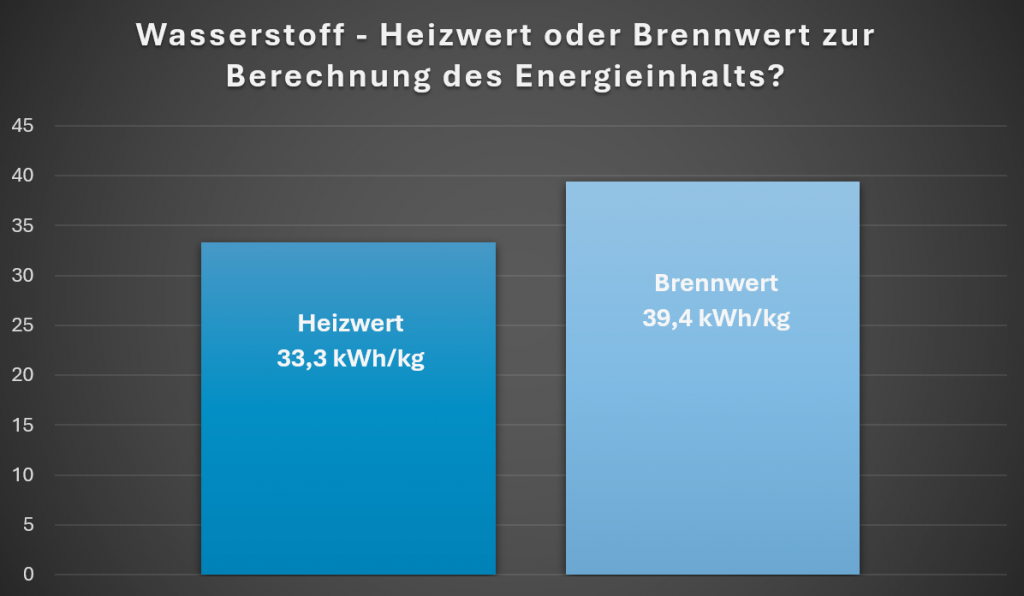
However, hydrogen is rarely "burned" directly, but is usually utilized in an electrochemical process. Which energy content figure should therefore be used for calculations in the hydrogen sector? Gross calorific value (39.4 kWh/kg) or net calorific value (33.3 kWh/kg)?
Chemical Background
The underlying process is decisive for the answer: when hydrogen is converted, water is produced, which can be liquid or gaseous depending on the type of process. If the water escapes unused as water vapor, the net calorific value is used for the calculation. However, if it liquefies within the process under consideration, the enthalpy of vaporization of the water is also "used", which is why the gross calorific value must be applied here. The discrepancy between the net and gross calorific value therefore corresponds in magnitude to the enthalpy of vaporization of the product water.
Depending on the type and load of a fuel cell, the "exhaust gas" (water/water vapor) is produced in different compositions. In most hydrogen vehicles, for example, a proton exchange membrane fuel cell is installed, which at average load produces predominantly water vapor but also some liquid water. However, liquid water is usually only produced at a later stage through condensation and not directly in the electrochemical process, which is why the released enthalpy of vaporization does not contribute to electrochemical power generation but can at most still be used as waste heat.
The behavior may also differ for other types of fuel cells; however, the fundamental principle is that only a portion of the energy contained in the fuel can be directly converted into electrical energy.
Conclusion – Net or Gross Calorific Value?
In order to calculate the energy content that can ultimately be converted into electricity within the fuel cell, the lower heating value (net calorific value) should therefore be used in the vast majority of cases!
If, for example, a process is considered in which the resulting condensation heat is also utilized, the gross calorific value can also be used to calculate the usable energy, depending on the design of the fuel cell. For special fuel cell types, it cannot generally be excluded that additional waste heat is also energetically utilized; however, a direct electrochemical utilization of the enthalpy of vaporization does not occur. More important for calculating the energy yield is anyway the use of a suitable efficiency factor (which ideally also describes the percentage share of thermal and electrical energy), as the possible fluctuations here are usually far greater than the percentage difference between the net and gross calorific value.
Note: When producing hydrogen by electrolysis, at least the gross calorific value must be used for energy assessment. The reason: electrolysis uses liquid water as a reactant. The reaction enthalpy therefore refers to the state with liquid product water — which corresponds to the definition of the gross calorific value. It therefore describes the total stored chemical energy of the hydrogen produced and represents the theoretical lower limit for energy input at an efficiency of 100%.
Additional info: Thermodynamic classification (Gibbs energy):
The energy contained in hydrogen can be described thermodynamically by the enthalpy (ΔH) and the free Gibbs energy (ΔG). It should be noted that ΔH, depending on the reference state of the product water, corresponds either to the gross calorific value (liquid water) or the net calorific value (gaseous water). ΔG describes the portion that can be maximally converted into electrical energy. The difference between ΔH and ΔG is temperature-dependent (ΔG = ΔH − TΔS) and must be released as heat. Fuel cells are therefore fundamentally limited by the Gibbs energy and cannot convert the entire enthalpy into electricity even in the ideal case. This is a key reason why efficiencies are typically referenced to the net calorific value.
Energy contents of other substances or H₂-containing compounds: https://www.energie-lexikon.info/wasserstoff.html
All information has been researched and fact-checked to the best of my knowledge. Please contact me if you notice any errors. Any use is therefore at your own risk. Any legal or financial claims are excluded.